User:Hoskir/Revision Request 4304: Difference between revisions
Created page with "=={{SpanID|903.2.60}}903.2.60 Barricades (MUTCD Section 2B.75)== '''Support.''' MoDOT uses three types of barricades: * '''Type 1 and Type 3 Barricades''' for Temporary Traffic Control applications – white on orange portable barricades are used to supplement temporary traffic control signs (single rail Type 1) and to close access to lanes or roadways (three rail type 3), see 616.11_Temporary_Traffic_Control_Zone_Channelizing_Devices_(MUTCD_Chapter_6K)#616.11.7_Type..." |
No edit summary |
||
| Line 44: | Line 44: | ||
The Shoulder Barricade is one additional enhancement option, using the 72” x 36” Two-Direction Large Arrow sign in conjunction with barricade panels to maximize the visibility of the assembly. Post delineation strips can also be added to this assembly for additional conspicuity. | The Shoulder Barricade is one additional enhancement option, using the 72” x 36” Two-Direction Large Arrow sign in conjunction with barricade panels to maximize the visibility of the assembly. Post delineation strips can also be added to this assembly for additional conspicuity. | ||
'''Standard.''' When used, the middle barricade rail of the shoulder barricade is omitted and the Large 72 x 36” extruded panel Two-Directional Arrow is installed between the top and bottom barricade rails. The 45-degree black and fluorescent yellow bars shall slope down from the center of the barricade rail from right to left on the left side of the rail and from left to right on the right side of the rail. The Shoulder Barricade – Two-Directional Arrow assembly shall be installed immediately inline and centered with the lane of traffic approaching the intersection along the shaft of the T-Intersection, this places the assembly in direct line of sight of the driver for maximum visibility and conspicuity. See MoDOT Standard Plans for Highway Construction 903.03 for proper Shoulder Barricade assembly details. | '''Standard.''' When used, the middle barricade rail of the shoulder barricade is omitted and the Large 72 x 36” extruded panel Two-Directional Arrow is installed between the top and bottom barricade rails. The 45-degree black and fluorescent yellow bars shall slope down from the center of the barricade rail from right to left on the left side of the rail and from left to right on the right side of the rail. The Shoulder Barricade – Two-Directional Arrow assembly shall be installed immediately inline and centered with the lane of traffic approaching the intersection along the shaft of the T-Intersection, this places the assembly in direct line of sight of the driver for maximum visibility and conspicuity. See [https://www.modot.org/standard-plans-section-900 MoDOT Standard Plans for Highway Construction 903.03] for proper Shoulder Barricade assembly details. | ||
The mounting height of the Shoulder Barricade – Two-Directional Arrow assembly shall match the guidance in EPG 903.1.13, with the mounting height measured from the road surface to the bottom of the lowest barricade panel. | The mounting height of the Shoulder Barricade – Two-Directional Arrow assembly shall match the guidance in [903.1_General_(MUTCD_Chapter_2A)#903.1.13_Standardization_of_Location_(MUTCD_Section_2A.13) EPG 903.1.13], with the mounting height measured from the road surface to the bottom of the lowest barricade panel. | ||
'''Guidance.''' The offset location for the Shoulder Barricade – Two-Directional Arrow assembly should be placed as close to the right of way line as practical (on right of way with typical widths) to minimize the likelihood of the assembly from being impacted by traffic traveling along the roadway parallel to the sign. | '''Guidance.''' The offset location for the Shoulder Barricade – Two-Directional Arrow assembly should be placed as close to the right of way line as practical (on right of way with typical widths) to minimize the likelihood of the assembly from being impacted by traffic traveling along the roadway parallel to the sign. | ||
<gallery mode="packed" heights=400> | |||
File:Barricade_T_Intersection_placement.png|'''Placement of T-Intersection Barricade''' | |||
</gallery> | |||
===903.2.60.2 Sign Barricades=== | |||
<gallery mode="packed"> | |||
File:GB-2.png|alt=Sign GB 2 | |||
File:GB-3.png|alt=Sign GB 3 | |||
File:GB-5.png|alt=Sign GB 5 | |||
</gallery> | |||
'''Support.''' The red and white Sign Barricades are used as a supplement to standard signing where roadways terminate. Roadway terminations can include a true dead-end condition, or the end of roadway alignment where traffic can continue using an alternate path requiring a change of alignment. Sign Barricades are used to supplement traditional signing when the traditional treatments are determined to be insufficient based on engineering judgement. | |||
'''Standard.''' The Sign Barricade assembly shall consist of a 12-foot wide by 6-foot tall, extruded aluminum sign with alternating retroreflective red and white bars set at a 45-degree angle. This sign shall be installed on two MoDOT #1 I-Beam posts, with one Type 4 Object Marker installed on each post directly below the fuse plate. See [https://www.modot.org/standard-plans-section-900 MoDOT Standard Plans for Highway Construction 903.03] for proper Shoulder Barricade assembly details. | |||
====903.2.60.2.1 Sign Barricades at Dead-End Locations==== | |||
<gallery mode="packed"> | |||
File:GB-5.png|alt=Sign GB 5 | |||
</gallery> | |||
'''Standard.''' When the Sign Barricade is used at the dead-end location which has no alternative path, the red and white bars shall be angled downward from left to right on the left side of the sign and from right to left on the right side of the sign, meeting in the middle of the sign to form a “V” pattern (GB-5). No other signing shall be added to the face of the Sign Barricade in this application. The Sign Barricade shall be installed behind the traditional dead-end treatment with the Sign Barricade centered on the centerline of the roadway. | |||
903.2.60.2 Sign Barricades | [[File:Dead-End_barricade.png|center|500px|alt=Image Dead-End Barricade Sign|Image Dead-End Barricade Sign]] | ||
'''Option.''' Based on engineering judgement, multiple Sign Barricades may be installed side by side in close proximity to form one larger sign barricade treatment for wider roadway applications. When multiple Sign Barricades are used together, the “V” pattern must be maintained: | |||
* If two Sign Barricades are used together side by side (in a set of 2 or a set of 4), the barricade(s) on the left will be the GB-2 (with no arrow sign) and the barricade(s) on the right will be the GB-3 (with no arrow sign). The group of Sign Barricades will replicate the “V” patter of the single GB-5 with the center of the “V” pattern placed on the centerline of the roadway. | |||
* If three Sign Barricades are used together side by side (or in a larger group of odd numbered barricade assemblies) the center Sign Barricade will be the GB-5, placed on the centerline of the roadway, the barricade(s) on the left will be the GB-2 (with no arrow sign) and the barricade(s) on the right will be the GB-3 (with no arrow sign). | |||
====903.2.60.2.2 Sign Barricades for End of Roadway with Changes to Alignment==== | |||
<gallery mode="packed"> | |||
File:GB-2.png|alt=Sign GB 2 | |||
File:GB-3.png|alt=Sign GB 3 | |||
</gallery> | |||
Support. | '''Support.''' The end of roadway with a change of alignment condition is typically where a multi-lane divided highway ends and transitions to a two-lane roadway. Multi-lane roadways will be narrowed down to one lane of traffic prior to this type of transition. | ||
Standard. When the Sign Barricade is used at end of roadway locations where the travel path continues onto a new alignment, the appropriate Sign Barricade with directional arrow shall be used to indicate the direction to the alternate travel path. The Sign Barricade (GB-2 or GB-3) shall be centered on the lane of travel approaching the change of alignment. | |||
'''Option.''' Based on engineering judgement, multiple Sign Barricades with arrows (red and white bars and arrows oriented in the same direction) may be installed side by side when additional emphasis is required to direct traffic along the proper path. | |||
Standard. When the Sign Barricade is used at end of roadway locations where the travel path continues onto a new alignment, the appropriate Sign Barricade with directional arrow shall be used to indicate the direction to the alternate travel path. | |||
Option. Based on engineering judgement, multiple Sign Barricades with arrows (red and white bars and arrows oriented in the same direction) may be installed side by side when additional emphasis is required to direct traffic along the proper path. | |||
Example of Sign Barricade Application | Example of Sign Barricade Application | ||
Revision as of 13:10, 16 November 2026
903.2.60 Barricades (MUTCD Section 2B.75)
Support. MoDOT uses three types of barricades:
- Type 1 and Type 3 Barricades for Temporary Traffic Control applications – white on orange portable barricades are used to supplement temporary traffic control signs (single rail Type 1) and to close access to lanes or roadways (three rail type 3), see EPG 616.11.7. The Black / Orange type 1 and type 3 barricades emphasize the temporary traffic control nature of the barricade.
- Shoulder Barricades – black and yellow three rail barricades are used to add conspicuity to advanced warning signs when other enhancement options are determined to be insufficient. These barricades are traditionally used on conventional two-lane roadways and on expressways. The Yellow / Black color of the shoulder barricade enhances the conspicuity of the warning message it carries.
- Sign Barricades – red and white barricade structural signs are used at transitions from 4 lane divided highways to two lane roadways when chevrons are determined to be insufficient, or at a dead end of a conventional two-lane roadway when the standard series of Type 4 Object markers is determined to be insufficient. The Red / White color of the barricade sign indicates the termination of a roadway.
903.2.60.1 Shoulder Barricades

Support. Black and yellow Shoulder Barricades are used when other forms of warning sign enhancements are determined to be insufficient to address the conditions at a specific location based on engineering judgement, enhancements such as:
- The use of post delineation strips to add conspicuity
- The use of an oversized warning sign
- Double posting the warning sign on the left and right side of the road
These warning sign enhancements can all be supported on PSST signposts, easily installed and maintained by general maintenance forces. Shoulder Barricade assemblies, however, are too large and exceed the capacity of PSST posts requiring the use of Pipe or I-Beam post.
903.2.60.1.1 Shoulder Barricades with Advanced Warning Signs

Standard. The shoulder barricade assembly shall consist of three 96-inch by 12-inch horizontal rails, separated by 12-inch spaces, marked with alternating black and reflective fluorescent yellow diagonal bars set at 45 degrees. The bars shall slope from top to bottom towards the roadway they are placed adjacent to:
- Shoulder Barricades that are installed on the right side of the road shall have bars sloping downward from right to left (GB-1R).
- Supplemental Shoulder Barricades installed on the left side of the road shall have bars sloping downward left to right (GB-1L).
When used, only 48-inch diamond warning signs shall be used with Shoulder Barricades, with or without supplemental plaques. When a warning sign is installed on a Shoulder Barricade with a supplemental plaque, the diamond warning signs shall be centered vertically on the top barricade rail, when a warning sign is installed on a Shoulder Barricade without a supplemental plaque, the diamond warning sign shall be centered vertically on the center barricade rail. See MoDOT Standard Plans for Highway Construction 903.03 for proper Shoulder Barricade assembly details.
Shoulder barricades shall be installed following standard sign offset and sign mounting heights, see EPG 903.1.13, with the mounting height measured from the road surface to the bottom of the lowest barricade panels.
Shoulder Barricades installed within or around intersections shall be installed on two 4-inch Pipe Posts. Pipe Posts are the only MoDOT post design that is multi-directionally breakaway suitable to support shoulder barricades.
Option. Shoulder Barricades may be installed on two #1 I-Beams only if the installation is along a tangent section of roadway away from the influence of intersections.
903.2.60.1.2 Shoulder Barricade at T-Intersections

Support. The typical sign at the far side of a T-Intersection is the standard 48” x 24” Two-Direction Large Arrow sign placed directly in front of the lane of traffic approaching the crossroad of the “T”. This sign can be enhanced with post delineation strips or by installing the oversized 72” x 36” Two-Direction Large Arrow sign for greater conspicuity, see EPG 903.3.35 Two-Direction Large Arrow Sign.
The Shoulder Barricade is one additional enhancement option, using the 72” x 36” Two-Direction Large Arrow sign in conjunction with barricade panels to maximize the visibility of the assembly. Post delineation strips can also be added to this assembly for additional conspicuity.
Standard. When used, the middle barricade rail of the shoulder barricade is omitted and the Large 72 x 36” extruded panel Two-Directional Arrow is installed between the top and bottom barricade rails. The 45-degree black and fluorescent yellow bars shall slope down from the center of the barricade rail from right to left on the left side of the rail and from left to right on the right side of the rail. The Shoulder Barricade – Two-Directional Arrow assembly shall be installed immediately inline and centered with the lane of traffic approaching the intersection along the shaft of the T-Intersection, this places the assembly in direct line of sight of the driver for maximum visibility and conspicuity. See MoDOT Standard Plans for Highway Construction 903.03 for proper Shoulder Barricade assembly details.
The mounting height of the Shoulder Barricade – Two-Directional Arrow assembly shall match the guidance in [903.1_General_(MUTCD_Chapter_2A)#903.1.13_Standardization_of_Location_(MUTCD_Section_2A.13) EPG 903.1.13], with the mounting height measured from the road surface to the bottom of the lowest barricade panel.
Guidance. The offset location for the Shoulder Barricade – Two-Directional Arrow assembly should be placed as close to the right of way line as practical (on right of way with typical widths) to minimize the likelihood of the assembly from being impacted by traffic traveling along the roadway parallel to the sign.
-
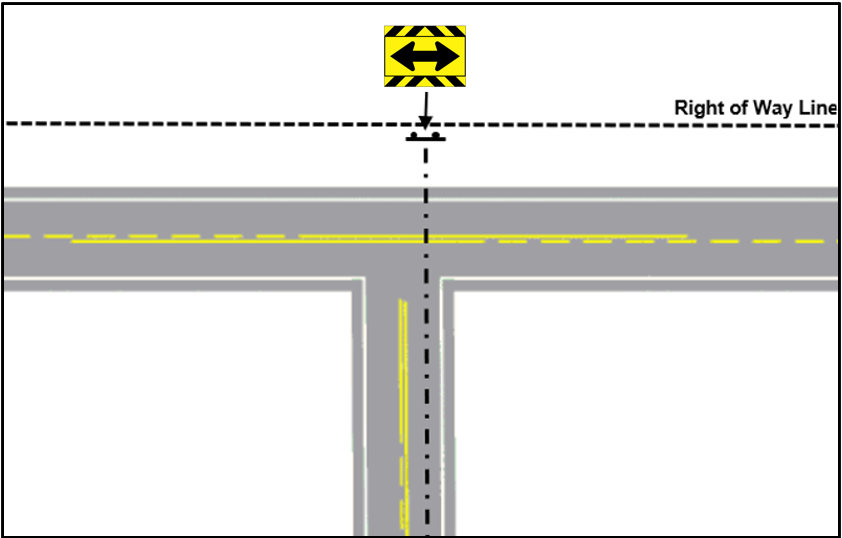 Placement of T-Intersection Barricade

903.2.60.2 Sign Barricades


Support. The red and white Sign Barricades are used as a supplement to standard signing where roadways terminate. Roadway terminations can include a true dead-end condition, or the end of roadway alignment where traffic can continue using an alternate path requiring a change of alignment. Sign Barricades are used to supplement traditional signing when the traditional treatments are determined to be insufficient based on engineering judgement.
Standard. The Sign Barricade assembly shall consist of a 12-foot wide by 6-foot tall, extruded aluminum sign with alternating retroreflective red and white bars set at a 45-degree angle. This sign shall be installed on two MoDOT #1 I-Beam posts, with one Type 4 Object Marker installed on each post directly below the fuse plate. See MoDOT Standard Plans for Highway Construction 903.03 for proper Shoulder Barricade assembly details.
903.2.60.2.1 Sign Barricades at Dead-End Locations
Standard. When the Sign Barricade is used at the dead-end location which has no alternative path, the red and white bars shall be angled downward from left to right on the left side of the sign and from right to left on the right side of the sign, meeting in the middle of the sign to form a “V” pattern (GB-5). No other signing shall be added to the face of the Sign Barricade in this application. The Sign Barricade shall be installed behind the traditional dead-end treatment with the Sign Barricade centered on the centerline of the roadway.

Option. Based on engineering judgement, multiple Sign Barricades may be installed side by side in close proximity to form one larger sign barricade treatment for wider roadway applications. When multiple Sign Barricades are used together, the “V” pattern must be maintained:
- If two Sign Barricades are used together side by side (in a set of 2 or a set of 4), the barricade(s) on the left will be the GB-2 (with no arrow sign) and the barricade(s) on the right will be the GB-3 (with no arrow sign). The group of Sign Barricades will replicate the “V” patter of the single GB-5 with the center of the “V” pattern placed on the centerline of the roadway.
- If three Sign Barricades are used together side by side (or in a larger group of odd numbered barricade assemblies) the center Sign Barricade will be the GB-5, placed on the centerline of the roadway, the barricade(s) on the left will be the GB-2 (with no arrow sign) and the barricade(s) on the right will be the GB-3 (with no arrow sign).
903.2.60.2.2 Sign Barricades for End of Roadway with Changes to Alignment
Support. The end of roadway with a change of alignment condition is typically where a multi-lane divided highway ends and transitions to a two-lane roadway. Multi-lane roadways will be narrowed down to one lane of traffic prior to this type of transition. Standard. When the Sign Barricade is used at end of roadway locations where the travel path continues onto a new alignment, the appropriate Sign Barricade with directional arrow shall be used to indicate the direction to the alternate travel path. The Sign Barricade (GB-2 or GB-3) shall be centered on the lane of travel approaching the change of alignment.
Option. Based on engineering judgement, multiple Sign Barricades with arrows (red and white bars and arrows oriented in the same direction) may be installed side by side when additional emphasis is required to direct traffic along the proper path. Example of Sign Barricade Application