User talk:Hoskir: Difference between revisions
| Line 1,061: | Line 1,061: | ||
=='''EPG 626.2 Centerline Rumble Strips'''== | =='''EPG 626.2 Centerline Rumble Strips'''== | ||
[[Image:626. | [[Image:626.2_Median_Rumble_Strip_passing_10-22.jpg|right|400px|thumb|<center>''' Example of a Median Rumble Strip with Passing Lanes'''</center>]] | ||
[[Image:626.2 Centerline Rumble Strip Marking for Two Lane Roadway_10-22.jpg|left| 200px|thumb|<center>''' Centerline Rumble Strip Marking for Two-Lane Roadway'''</center>]] | |||
[[image:626.2 Passing Lane Centerline Rumble Strip marking_10-22.jpg|left| 275px|thumb|<center>'''[[232.2 Passing Lanes|Passing Lane]] Centerline Rumble Strip Marking'''</center>]] | [[image:626.2 Passing Lane Centerline Rumble Strip marking_10-22.jpg|left| 275px|thumb|<center>'''[[232.2 Passing Lanes|Passing Lane]] Centerline Rumble Strip Marking'''</center>]] | ||
All two-lane [[media:144 Major Highway System 2022.pdf|major roads]] with new pavement will have centerline rumble strips (see figure at right) unless the posted speed is less than 50 mph. Centerline rumble strips are provided on all major two-lane roads, and on minor roads with a cross-centerline [https://www.modot.org/about-traffic-safety crash history]. Rumble strips on a centerline have been shown to reduce head-on crashes by alerting drivers that they are leaving their lane of travel. On roadways with a travelway width of 20 ft. or less, centerline rumble strips become obtrusive and are not recommended. | |||
As with edgeline rumble strips, pavement marking material is sprayed over the centerline rumble strip, creating what is often called a “rumble stripe.” | As with edgeline rumble strips, pavement marking material is sprayed over the centerline rumble strip, creating what is often called a “rumble stripe.” | ||
Rumble strips in the median of typical passing lane roadways (see [https://www.modot.org/media/16900 Std. Plan 626.00 Rumble Strips]) vary somewhat from centerline rumble strips on typical two-lane roadways (see figure, to the left). Passing lanes can operate effectively with no separation between opposing lanes of travel. While no separation is required, AASHTO guidance recommends that some separation, however small, between the lanes in opposite directions of travel is desirable. Therefore, a flush median separation of a minimum of 3 ft. between the opposing directions of travel is required on new passing lane roadways retrofitted on existing alignment and a minimum median separation width of 4 feet on any passing lane roadway constructed on new alignment (See Std. Plan 620.00 for pavement marking details and Std. Plan 626.00 for rumble strip details). | Rumble strips in the median of typical passing lane roadways (see [https://www.modot.org/media/16900 Std. Plan 626.00 Rumble Strips]) vary somewhat from centerline rumble strips on typical two-lane roadways (see figure, to the left). Passing lanes can operate effectively with no separation between opposing lanes of travel. While no separation is required, AASHTO guidance recommends that some separation, however small, between the lanes in opposite directions of travel is desirable. Therefore, a flush median separation of a minimum of 3 ft. between the opposing directions of travel is required on new passing lane roadways retrofitted on existing alignment and a minimum median separation width of 4 feet on any passing lane roadway constructed on new alignment (See Std. Plan 620.00 for pavement marking details and Std. Plan 626.00 for rumble strip details). | ||
In order to maintain the integrity of the rumble strip and the pavement, the pavement material must be either concrete or the top lift of bituminous material must be at least 1 inch thick. Centerline rumble strips are not to be placed on bridges or within the limits of an intersection with left turn lanes. The limits of the intersection are defined by the beginning of the tapers for the left turn lanes. The length of centerline rumble strip installation should be estimated and pay items provided. | In order to maintain the integrity of the rumble strip and the pavement, the pavement material must be either concrete or the top lift of bituminous material must be at least 1 inch thick. Centerline rumble strips are not to be placed on bridges or within the limits of an intersection with left turn lanes. The limits of the intersection are defined by the beginning of the tapers for the left turn lanes. The length of centerline rumble strip installation should be estimated and pay items provided. | ||
Revision as of 13:08, 30 May 2025
REVISION REQUEST 4023
751.24.2.1 Design
Designs of Mechanically Stabilized Earth (MSE) walls shall be completed by consultants or contractors in accordance with Section 11.10 of LRFD specifications, FHWA-NHI-10-024 and FHWA-NHI-10-025 for LRFD. Bridge Pre-qualified Products List (BPPL) provided on MoDOT's web page and in Sharepoint contains a listing of facing unit manufacturers, soil reinforcement suppliers, and wall system suppliers which have been approved for use. See Sec 720 and Sec 1010 for additional information. The Geotechnical Section is responsible for checking global stability of permanent MSE wall systems, which should be reported in the Foundation Investigation Geotechnical Report. For MSE wall preliminary information, see EPG 751.1.4.3 MSE Walls. For design requirements of MSE wall systems and temporary shoring (including temporary MSE walls), see EPG 720 Mechanically Stabilized Earth Wall Systems. For staged bridge construction, see EPG 751.1.2.11 Staged Construction.
For seismic design requirements, see Bridge Seismic Design Flowchart. References for consultants and contractors include Section 11.10 of LRFD, FHWA-NHI-10-024 and FHWA-NHI-10-025.
Design Life
- 75 year minimum for permanent walls (if retained foundation require 100 year than consider 100 year minimum design life for wall).
Global stability:
Global stability will be performed by Geotechnical Section or their agent.
MSE wall contractor/designer responsibility:
MSE wall contractor/designer shall perform following analysis in their design for all applicable limit states.
- External Stability
- Limiting Eccentricity
- Sliding
- Factored Bearing Pressure/Stress ≤ Factored Bearing Resistance
- Internal Stability
- Tensile Resistance of Reinforcement
- Pullout Resistance of Reinforcement
- Structural Resistance of Face Elements
- Structural Resistance of Face Element Connections
- Compound Stability
- Capacity/Demand ratio (CDR) for bearing capacity shall be ≥ 1.0
- Strength Limit States:
- Factored bearing resistance = Nominal bearing resistance from Geotech report X Minimum Resistance factor (0.65, Geotech report) LRFD Table 11.5.7-1
- Extreme Event I Limit State:
- Factored bearing resistance = Nominal bearing resistance from Geotech report X Resistance factor
- Resistance factor = 0.9 LRFD 11.8.6.1
- Factored bearing stress shall be computed using a uniform base pressure distribution over an effective width of footing determined in accordance with the provisions of LRFD 10.6.3.1 and 10.6.3.2, 11.10.5.4 and Figure 11.6.3.2-1 for foundation supported on soil or rock.
- B’ = L – 2e
- Where,
- L = Soil reinforcement length (For modular block use B in lieu of L as per LRFD 11.10.2-1)
- B’ = effective width of footing
- e = eccentricity
- Note: When the value of eccentricity e is negative then B´ = L.
- Where,
- Capacity/Demand ratio (CDR) for overturning shall be ≥ 1.0
- Capacity/Demand ratio (CDR) for eccentricity shall be ≥ 1.0
- Capacity/Demand ratio (CDR) for sliding shall be ≥ 1.0 LRFD 11.10.5.3 & 10.6.3.4
- Capacity/Demand ratio (CDR) for internal stability shall be ≥ 1.0
- Eccentricity, (e) Limit for Strength Limit State: LRFD 11.6.3.3 & C11.10.5.4
- For foundations supported on soil or rock, the location of the resultant of the reaction forces shall be within the middle two-thirds of the base width, L or (e ≤ 0.33L).
- Eccentricity, (e) Limit for Strength Limit State: LRFD 11.6.3.3 & C11.10.5.4
- Eccentricity, (e) Limit for Extreme Event I (Seismic): LRFD 11.6.5.1
- For foundations supported on soil or rock, the location of the resultant of the reaction forces shall be within the middle two-thirds of the base width, L or (e ≤ 0.33L) for γEQ = 0.0 and middle eight-tenths of the base width, L or (e ≤ 0.40L) for γEQ = 1.0. For γEQ between 0.0 and 1.0, interpolate e value linearly between 0.33L and 0.40L. For γEQ refer to LRFD 3.4.
- Eccentricity, (e) Limit for Extreme Event I (Seismic): LRFD 11.6.5.1
- Note: Seismic design shall be performed for γEQ = 0.5
- Eccentricity, (e) Limit for Extreme Event II:
- For foundations supported on soil or rock, the location of the resultant of the reaction forces shall be within the middle eight-tenths of the base width, L or (e ≤ 0.40L).
- Eccentricity, (e) Limit for Extreme Event II:
General Guidelines
- Drycast modular block wall (DMBW-MSE) systems are limited to a 10 ft. height in one lift.
- Wetcast modular block wall (WMBW-MSE) systems are limited to a 15 ft. height in one lift.
- For Drycast modular block wall (DMBW-MSE) systems and Wetcast modular block wall (WMBW-MSE) systems, top cap units shall be used and shall be permanently attached by means of a resin anchor system.
- For precast modular panel wall (PMPW-MSE) systems, capstone may be substituted for coping and either shall be permanently attached to wall by panel dowels.
- For precast modular panel wall (PMPW-MSE) systems, form liners are required to produce all panels. Using form liner to produce panel facing is more cost effective than producing flat panels. Standard form liners are specified on the MSE Wall Standard Drawings. Be specific regarding names, types and colors of staining, and names and types of form liner.
- MSE walls shall not be used where exposure to acid water may occur such as in areas of coal mining.
- MSE walls shall not be used where scour is a problem.
- MSE walls with metallic soil reinforcement shall not be used where stray electrical ground currents may occur as would be present near electrical substations.
- No utilities shall be allowed in the reinforced earth if future access to the utilities would require that the reinforcement layers be cut, or if there is a potential for material, which can cause degradation of the soil reinforcement, to leak out of the utilities into the wall backfill, with the exception of storm water drainage.
- All vertical objects shall have at least 4’-6” clear space between back of the wall facing and object for select granular backfill compaction and soil reinforcement skew limit requirements. For piles, see pipe pile spacers guidance.
- The interior angle between two MSE walls should be greater than 70°. However, if unavoidable, then place EPG 751.50 J1.41 note on the design plans.
- Drycast modular block wall (DMBW-MSE) systems and Wetcast modular block wall (WMBW-MSE) systems may be battered up to 1.5 in. per foot. Modular blocks are also known as “segmental blocks”.
- The friction angle used for the computation of horizontal forces within the reinforced soil shall be greater than or equal to 34°.
- For epoxy coated reinforcement requirements, see EPG 751.5.9.2.2 Epoxy Coated Reinforcement Requirements.
- All concrete except facing panels or units shall be CLASS B or B-1.
- The friction angle of the soil to be retained by the reinforced earth shall be listed on the plans as well as the friction angle for the foundation material the wall is to rest on.
- The following requirement shall be considered (from 2009_FHWA-NHI-10-024 MSE wall 132042.pdf, page 200-201) when seismic design is required:
- For seismic design category, SDC C or D (Zones 3 or 4), facing connections in modular block faced walls (MBW) shall use shear resisting devices (shear keys, pin, etc.) between the MBW units and soil reinforcement, and shall not be fully dependent on frictional resistance between the soil reinforcement and facing blocks. For connections partially dependent on friction between the facing blocks and the soil reinforcement, the nominal long-term connection strength Tac, should be reduced to 80 percent of its static value.
- Seismic design category and acceleration coefficients shall be listed on the plans for categories B, C and D. If a seismic analysis is required that shall also be noted on the plans. See EPG 751.50 A1.1 note.
- Plans note (EPG 751.50 J1.1) is required to clearly identify the responsibilities of the wall designer.
- Do not use Drycast modular block wall (DMBW-MSE) systems in the following locations:
- Within the splash zone from snow removal operations (assumed to be 15 feet from the edge of the shoulder).
- Where the blocks will be continuously wetted, such as around sources of water.
- Where blocks will be located behind barrier or other obstacles that will trap salt-laden snow from removal operations.
- Do not use Drycast modular block wall (DMBW-MSE) systems or Wetcast modular block wall (WMBW-MSE) systems in the following locations:
- For structurally critical applications, such as containing necessary fill around structures.
- In tiered wall systems.
- For locations where Drycast modular block wall (DMBW-MSE) systems and Wetcast modular block wall (WMBW-MSE) systems are not desirable, consider coloring agents and/or architectural forms using precast modular panel wall (PMPW-MSE) systems for aesthetic installations.
- For slab drain location near MSE Wall, see EPG 751.10.3.1 Drain Type, Alignment and Spacing and EPG 751.10.3.3 General Requirements for Location of Slab Drains.
- Roadway runoff should be directed away from running along face of MSE walls used as wing walls on bridge structures.
- Drainage:
- Gutter type should be selected at the core team meeting.
- When gutter is required without fencing, use Type A or Type B gutter (for detail, see Std. Plan 609.00).
- When gutter is required with fencing, use Modified Type A or Modified Type B gutter (for detail, see Std. Plan 607.11).
- When fencing is required without gutter, place in tube and grout behind the MSE wall (for detail, see MSE Wall Standard Drawings - MSEW, Fence Post Connection Behind MSE Wall (without gutter).
- Lower backfill longitudinal drainage pipes behind all MSE walls shall be two-6” (Min.) diameter perforated PVC or PE pipe (See Sec 1013) unless larger sizes are required by design which shall be the responsibility of the District Design Division. Show drainage pipe size on plans. Outlet screens and cleanouts should be detailed for any drain pipe (shown on MoDOT MSE wall plans or roadway plans). Lateral non-perforated drain pipes (below leveling pad) are permitted by Standard Specifications and shall be sized by the District Design Division if necessary. Lateral outlet drain pipe sloped at 2% minimum.
- Identify on MSE wall plans or roadway plans drainage pipe point of entry, point of outlet (daylighting), 2% min. drainage slopes in between points to ensure positive flow and additional longitudinal drainage pipes if required to accommodate ground slope changes and lateral drainage pipes if required by design.
- Adjustment in the vertical alignment of the longitudinal drainage pipes from that depicted on the MSE wall standard drawings may be necessary to ensure positive flow out of the drainage system.
- Identify on MSE wall plans or roadway plans the outlet ends of pipes which shall be located to prevent clogging or backflow into the drainage system. Outlet screens and cleanouts should be detailed for any drain pipe.
- For more information on drainage, see Drainage at MSE Walls.
MSE Wall Construction: Pipe Pile Spacers Guidance
For bridges not longer than 200 feet, pipe pile spacers or pile jackets shall be used at pile locations behind mechanically stabilized earth walls at end bents. Corrugated pipe pile spacers are required when the wall is built prior to driving the piles to protect the wall reinforcement when driving pile for the bridge substructure at end bents(s). Pile spacers or pile jackets may be used when the piles are driven before the wall is built. Pipe pile spacers shall have an inside diameter greater than that of the pile and large enough to avoid damage to the pipe when driving the pile. Use EPG 751.50 Standard Detailing Note E1.2a on bridge plans.
For bridges longer than 200 feet, pipe pile spacers are required and the pile spacer shall be oversized to mitigate the effects of bridge thermal movements on the MSE wall. For HP12, HP14, CIP 14” and CIP 16” piles provide 24-inch inside diameter of pile spacer for bridge movement. Minimum pile spacing shall be 5 feet to allow room for compaction of the soil layers. Use EPG 751.50 Standard Detailing Note E1.2b on bridge plans.
The bottom of the pipe pile spacers shall be placed 5 ft. min. below the bottom of the MSE wall leveling pad. The pipe shall be filled with sand or other approved material after the pile is placed and before driving. Pipe pile spacers shall be accurately located and capped for future pile construction.
Alternatively, for bridges shorter than or equal to 200 feet, the contractor shall be given the option of driving the piles before construction of the mechanically stabilized earth wall and placing the soil reinforcement and backfill material around the piling. In lieu of pipe pile spacers contractor may place pile jackets on the portion of the piles that will be in the MSE soil reinforced zone prior to placing the select granular backfill material and soil reinforcement. The contractor shall adequately support the piling to ensure that proper pile alignment is maintained during the wall construction. The contractor’s plan for bracing the pile shall be submitted to the engineer for review.
Piling shall be designed for downdrag (DD) loads due to either method. Oversized pipe pile spacers with sand placed after driving or pile jacket may be considered to mitigate some of the effects of downdrag (DD) loads. Sizing of pipe pile spacers shall account for pile size, thermal movements of the bridge, pile placement plan, and vertical and horizontal placement tolerances.
When rock is anticipated within the 5 feet zone below the MSE wall leveling pad, prebore into rock and prebore holes shall be sufficiently wide to allow for a minimum 10 feet embedment of pile and pipe pile spacer. When top of rock is anticipated within the 5 to 10 feet zone below the MSE wall leveling pad, prebore into rock to achieve a minimum embedment (pile only) of 10 feet below the bottom of leveling pad. Otherwise, the pipe pile spacer requires a minimum 5 feet embedment below the levelling pad. Consideration shall also be given to oversizing the prebore holes in rock to allow for temperature movements at integral end bents.
For bridges not longer than 200 feet, the minimum clearance from the back face of MSE walls to the front face of the end bent beam, also referred to as setback, shall be 4 ft. 6 in. (typ.) unless larger than 18-inch pipe pile spacer required. The 4 ft. 6 in. dimension serves a dual purpose:
- 1) the setback ensures that soil reinforcement is not skewed more than 15° for nut and bolt reinforcement connections to clear an 18-inch inside diameter pipe pile spacers by 6 inches per FHWA-NHI-10-24, Figure 5-17C, while considering vertical and horizontal pile placement tolerances
- 2) the setback helps to reduce the forces imparted on the MSE wall from bridge movements that typically are not accounted for in the wall design and cannot be completely isolated using a pipe pile spacer. Increasing the minimum setback shall be considered when larger diameter pile spacers are required or when other types of soil reinforcement connections are anticipated
For bridges longer than 200 feet, the minimum setback shall be 5 ft. 6 in. based on the use of 24-inch inside diameter of pipe pile spacers.
If interference with soil reinforcement is not a concern and the wall is designed for forces from bridge movement, the following guidance for pipe pile spacers clearance shall be used: pipe pile spacers shall be placed 36 in. clear min. from the back face of MSE wall panels to allow for proper compaction; 12 in. minimum clearance is required between pipe pile spacers and leveling pad and 18 in. minimum clearance is required between leveling pad and pile. For isolated pile (e.g, walls skewed from the bent orientation), the pipe pile spacer may be placed 18 in. clear min. from the back face of MSE wall panels.
MSE Wall Plan and Geometrics
- A plan view shall be drawn showing a baseline or centerline, roadway stations and wall offsets. The plan shall contain enough information to properly locate the wall. The ultimate right of way shall also be shown, unless it is of a significant distance from the wall and will have no effect on the wall design or construction.
- Stations and offsets shall be established between one construction baseline or roadway centerline and a wall control line (baseline). Some wall designs may contain a slight batter, while others are vertical. A wall control line shall be set at the front face of the wall, either along the top or at the base of the wall, whichever is critical to the proposed improvements. For battered walls, in order to allow for batter adjustments of the stepped level pad or variation of the top of the wall, the wall control line (baseline) is to be shown at a fixed elevation. For battered walls, the offset location and elevation of control line shall be indicated. All horizontal breaks in the wall shall be given station-offset points, and walls with curvature shall indicate the station-offsets to the PC and PT of the wall, and the radius, on the plans.
- Any obstacles which could possibly interfere with the soil reinforcement shall be shown. Drainage structures, lighting, or truss pedestals and footings, etc. are to be shown, with station offset to centerline of the obstacle, with obstacle size. Skew angles are shown to indicate the angle between a wall and a pipe or box which runs through the wall.
- Elevations at the top and bottom of the wall shall be shown at 25 ft. intervals and at any break points in the wall.
- Curve data and/or offsets shall be shown at all changes in horizontal alignment. If battered wall systems are used on curved structures, show offsets at 10 ft. (max.) intervals from the baseline.
- Details of any architectural finishes (formliners, concrete coloring, etc.).
- Details of threaded rod connecting the top cap block.
- Estimated quantities, total sq. ft. of mechanically stabilized earth systems.
- Proposed grade and theoretical top of leveling pad elevation shall be shown in constant slope. Slope line shall be adjusted per project. Top of wall or coping elevation and stationing shall be shown in the developed elevation per project. If leveling pad is anticipated to encounter rock, then contact the Geotechnical Section for leveling pad minimum embedment requirements.
MSE Wall Cross Sections
- A typical wall section for general information is shown.
- Additional sections are drawn for any special criteria. The front face of the wall is drawn vertical, regardless of the wall type.
- Any fencing and barrier or railing are shown.
- Barrier if needed are shown on the cross section. Barriers are attached to the roadway or shoulder pavement, not to the MSE wall. Standard barriers are placed along wall faces when traffic has access to the front face of the wall over shoulders of paved areas.
Drainage at MSE Walls
- Drainage Before MSE Wall
- Drainage is not allowed to be discharged within 10 ft. from front of MSE wall in order to protect wall embedment, prevent erosion and foundation undermining, and maintain soil strength and stability.
- Drainage Behind MSE Wall
- Internal (Subsurface) Drainage
- Groundwater and infiltrating surface waters are drained from behind the MSE wall through joints between the face panels or blocks (i.e. wall joints) and two-6 in. (min.) diameter pipes located at the base of the wall and at the basal interface between the reinforced backfill and the retained backfill.
- Excessive subsurface draining can lead to increased risk of backfill erosion/washout through the wall joints and erosion at the bottom of walls and at wall terminal ends. Excessive water build-up caused by inadequate drainage at the bottom of the wall can lead to decreased soil strength and wall instability. Bridge underdrainage (vertical drains at end bents and at approach slabs) can exacerbate the problem.
- Subsurface drainage pipes should be designed and sized appropriately to carry anticipated groundwater, incidental surface run-off that is not collected otherwise including possible effects of drainage created by an unexpected rupture of any roadway drainage conveyance or storage as an example.
- External (Surface) Drainage
- External drainage considerations deal with collecting water that could flow externally over and/or around the wall surface taxing the internal drainage and/or creating external erosion issues. It can also infiltrate the reinforced and retained backfill areas behind the MSE wall.
- Diverting water flow away from the reinforced soil structure is important. Roadway drainage should be collected in accordance with roadway drainage guidelines and bridge deck drainage should be collected similarly.
- Guidance
- ALL MSE WALLS
- 1. Appropriate measures to prevent surface water infiltration into MSE wall backfill should be included in the design and detail layout for all MSE walls and shown on the roadway plans.
- 2. Gutters behind MSE walls are required for flat or positive sloping backfills to prevent concentrated infiltration behind the wall facing regardless of when top of backfill is paved or unpaved. This avoids pocket erosion behind facing and protection of nearest-surface wall connections which are vulnerable to corrosion and deterioration. Drainage swales lined with concrete, paved or precast gutter can be used to collect and discharge surface water to an eventual point away from the wall. If rock is used, use impermeable geotextile under rock and align top of gutter to bottom of rock to drain. (For negative sloping backfills away from top of wall, use of gutters is not required.)
- District Design Division shall verify the size of the two-6 in. (min.) diameter lower perforated MSE wall drain pipes and where piping will daylight at ends of MSE wall or increase the diameters accordingly. This should be part of the preliminary design of the MSE wall. (This shall include when lateral pipes are required and where lateral drain pipes will daylight/discharge).
- BRIDGE ABUTMENTS WITH MSE WALLS
- Areas of concern: bridge deck drainage, approach slab drainage, approach roadway drainage, bridge underdrainage: vertical drains at end bents and approach slab underdrainage, showing drainage details on the roadway and MSE wall plans
- 3. Bridge slab drain design shall be in accordance with EPG 751.10.3 Bridge Deck Drainage – Slab Drains unless as modified below.
- 4. Coordination is required between the Bridge Division and District Design Division on drainage design and details to be shown on the MSE wall and roadway plans.
- 5. Bridge deck, approach slab and roadway drainage shall not be allowed to be discharged to MSE wall backfill area or within 10 feet from front of MSE wall.
- (Recommended) Use of a major bridge approach slab and approach pavement is ideal because bridge deck, approach slab and roadway drainage are directed using curbs and collected in drain basins for discharge that protect MSE wall backfill. For bridges not on a major roadway, consideration should be given to requiring a concrete bridge approach slab and pavement incorporating these same design elements (asphalt is permeable).
- (Less Recommended) Use of conduit and gutters:
- Conduit: Drain away from bridge and bury conduit daylighting to natural ground or roadway drainage ditch at an eventual point beyond the limits of the wall. Use expansion fittings to allow for bridge movement and consider placing conduit to front of MSE wall and discharging more than 10 feet from front of wall or using lower drain pipes to intercept slab drainage conduit running through backfill.
- Conduit and Gutters: Drain away from bridge using conduit and 90° elbow (or 45° bend) for smoothly directing drainage flow into gutters and that may be attached to inside of gutters to continue along downward sloping gutters along back of MSE wall to discharge to sewer or to natural drainage system, or to eventual point beyond the limits of the wall. Allow for independent bridge and wall movements by using expansion fittings where needed. See EPG 751.10.3.1 Type, Alignment and Spacing and EPG 751.10.3.3 General Requirements for Location of Slab Drains.
- 6. Vertical drains at end bents and approach slab underdrainage should be intercepted to drain away from bridge end and MSE wall.
- 7. Discharging deck drainage using many slab drains would seem to reduce the volume of bridge end drainage over MSE walls.
- 8. Drain flumes at bridge abutments with MSE walls do not reduce infiltration at MSE wall backfill areas and are not recommended.
- DISTRICT DESIGN DIVISION MSE WALLS
- Areas of concern: roadway or pavement drainage, MSE wall drainage, showing drainage details on the roadway and MSE wall plans.
- 9. For long MSE walls, where lower perforated drain pipe slope become excessive, non-perforated lateral drain pipes, permitted by Standard Specifications, shall be designed to intercept them and go underneath the concrete leveling pad with a 2% minimum slope. Lateral drain pipes shall daylight/discharge at least 10 ft. from front of MSE wall. Screens should be installed and maintained on drain pipe outlets.
- 10. Roadway and pavement drainage shall not be allowed to be discharged to MSE wall backfill area or within 10 feet from front of MSE wall.
- 11. For district design MSE walls, use roadway or pavement drainage collection pipes to transport and discharge to an eventual point outside the limits of the wall.
- Example: Showing drain pipe details on the MSE wall plans.
-
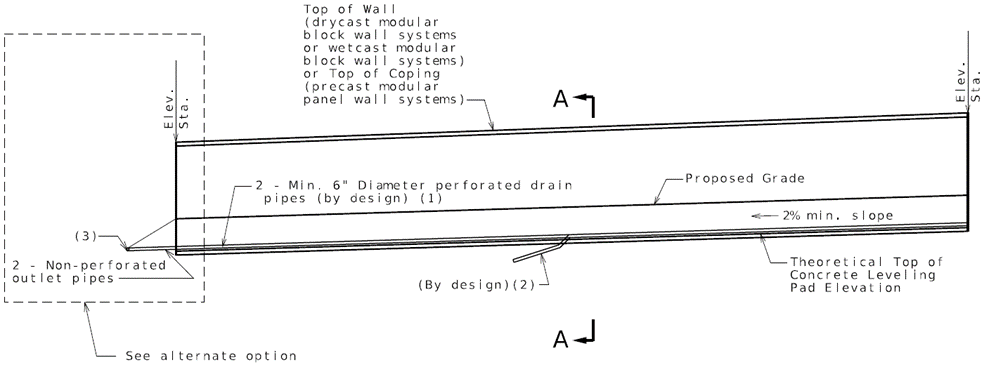 ELEVATION SHOWING DRAIN PIPE
 -
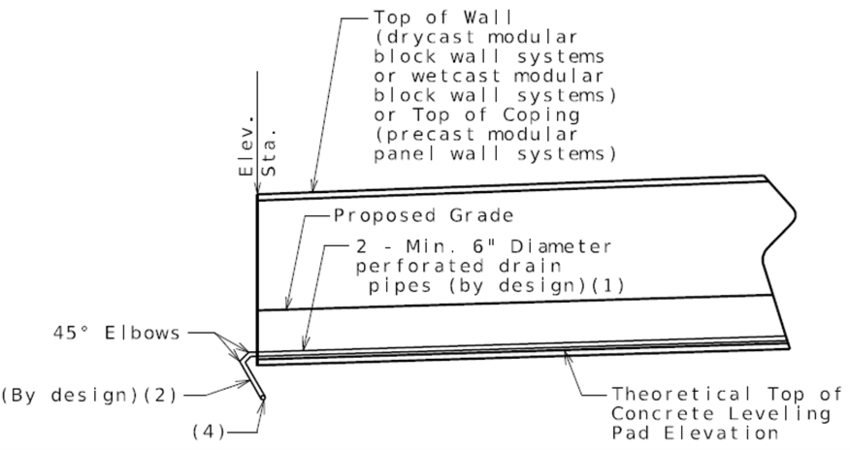 Alternate option


-
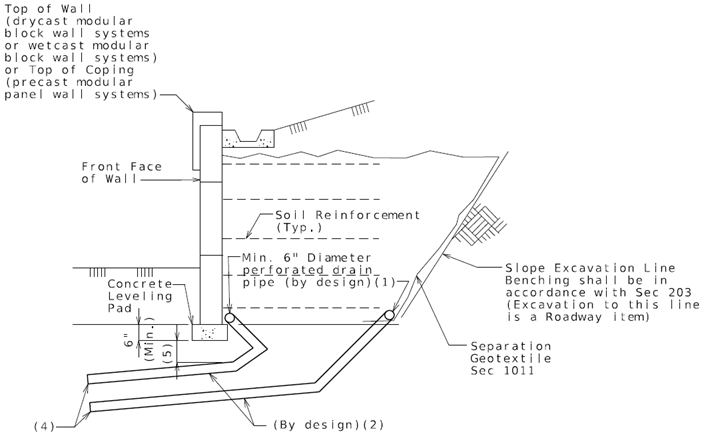 Section A-A

|
Notes: |
E1. Excavation and Fill
(E1.1) Use when specified on the Design Layout.
- Existing roadway fill under the ends of the bridge shall be removed as shown. Removal of existing roadway fill will be considered completely covered by the contract unit price for roadway excavation.
Use one of the following two notes where MSE walls support abutment fill.
(E1.2a) [MS Cell] Use when pipe pile spacers are shown on plan details and bridge is 200 feet long or shorter. Add “See special provisions” to the pipe pile spacer callout and add table near the callout.
See special provisions.
| Pile Encasement | Option Used (√) |
|---|---|
| Pipe Pile Spacer | |
| Pile Jacket |
MoDOT Construction personnel will indicate the pile encasement used.
(E1.2b) Use note when pipe pile spacers are shown on plan details for HP12, HP14, CIP 14” and CIP 16” piles and bridge is longer than 200 feet. For larger CIP pile size modify following note and use minimum 6” larger pipe pile spacer diameter than CIP pile.
The pipe pile spacers shall have an inside diameter equal to 24 inches.
(E1.4) Use for fill at pile cap end bents. Use the first underlined portion when MSE walls are present. Use approach for semi-deep abutments.
- Roadway fill, exclusive of Select Granular Backfill for Structural Systems, shall be completed to the final roadway section and up to the elevation of the bottom of the concrete approach beam within the limits of the structure and for not less than 25 feet in back of the fill face of the end bents before any piles are driven for any bents falling within the embankment section.
REVISION REQUEST 4034
!!! Only replace first part of 751.9.1 up to 751.9.1.1 !!!
751.9.1 Seismic Analysis and Design Specifications
All new or replacement bridges on the state system shall include seismic design and/or detailing to resist an expected seismic event per the Bridge Seismic Design Flowchart. For example, for a bridge in Seismic Design Categories A, B, C or D, complete seismic analysis or seismic detailing only may be determined as per “Bridge Seismic Design Flowchart”.
Missouri is divided into four Seismic Design Categories. Most of the state is SDC A which requires minimal seismic design and/or detailing in accordance with SGS (Seismic Zone 1 of LRFD) and “Bridge Seismic Design Flowchart”. The other seismic design categories will require a greater amount of seismic design and/or detailing.
For seismic detailing only:
When AS is greater than 0.75 then use AS = 0.75 for abutment design where required per “Bridge Seismic Design Flowchart” and SEG 24-01
For complete seismic analysis:
When AS is greater than 0.75 then use AS = 0.75 at zero second for seismic analysis and response spectrum curve. See Example 1_SDC_Response_Spectra. The other data points on the response spectrum curve shall not be modified.
When existing bridges are identified as needing repairs or maintenance, a decision on whether to include seismic retrofitting in the scope of the project shall be determined per the “Bridge Seismic Retrofit Flowchart”, the extent of the rehabilitation work and the expected life of the bridge after the work. For example, if the bridge needs painting or deck patching, no retrofitting is recommended. However, redecking or widening the bridge indicates that MoDOT is planning to keep the bridge in the state system with an expected life of at least 30 more years. In these instances, the project core team should consider cost effective methods of retrofitting the existing bridge. Superstructure replacement requires a good substructure and the core team shall decide whether there is sufficient seismic capacity. Follow the design procedures for new or replacement bridges in forming logical comparisons and assessing risk in a rational determination of the scope of a superstructure replacement project specific to the substructure. For example, based on SPC and route, retrofit of the substructure could include seismic detailing only or a complete seismic analysis may be required determine sufficient seismic capacity. Economic analysis should be considered as part of the decision to re-use and retrofit, or re-build. Where practical, make end bents integral and eliminate expansion joints. Seismic isolation systems shall conform to AASHTO Guide Specifications for Seismic Isolation Design 4th Ed. 2023.
Bridge seismic retrofit for widenings shall be in accordance with Bridge Seismic Retrofit Flowchart. Seismic details should only be considered for widenings where they can be practically implemented and where they can be uniformly implemented as not to create significant stress redistribution in the structure. When a complete seismic analysis is required for widenings the existing structure shall be retrofitted and the new structural elements shall be detailed to resist seismic demand.
- Seismic Details for Widening (one side): When widening the bridge in one direction there is not a significant benefit, and it could be detrimental, to strengthen a new wing or column while ignoring the existing structure. It may be practical to use FRP wrap to retrofit the existing columns to provide a similar level of service to a new column with seismic details, but this will likely require design computations to verify (see below). For SDC C and D, seismic details typically require a T-joint detail in the beam cap and footing, but t-joint details shall be ignored if the existing beam cap is not retrofitted. For abutments it is not practical to dig up an existing wing solely to match the new wing design so the abutment need not be designed for mass inertial forces. SPM, SLE or owner’s representative approval is required to determine the appropriate level of seismic detail implementation.
- Seismic Details for Widening (both sides): When widening in both directions the wings shall be designed to resist the mass inertial forces. Seismic details shall be added to the new columns in SDC B only if the existing columns can be retrofitted with FRP wrap to provide a similar level of service as discussed below. SDC C and D bridges may be detailed and retrofitted similar to SDC B since retrofitting the beam cap or footing is likely not practical.
- Seismic Details for Widening (FRP wrap): Carbon or glass fiber reinforced polymer (FRP) composite wrap should be considered to strengthen the factored axial resistance of existing columns. There are limitations to the existing and achievable column factored axial resistance with FRP wrap. The goal of the FRP wrap is to increase the factored axial resistance of the existing column to be not less than the factored axial resistance of the new column with seismic details. If an existing column cannot be retrofitted with FRP wrap to match the factored axial resistance of a new column with seismic details at the same bent then seismic details shall be ignored for all columns in the bridge substructure. See AASHTO Guide Spec for Design of Bonded FRP Systems for Repair and Strengthening of Concrete Bridge Elements, March 2023, 2nd Ed., Appendix A, Example 6 for an example for increasing column factored axial resistance with FRP wrap. Use EPG 751.50 Standard Detailing Notes I5 on plans to report factored axial resistance of existing column and new column. The flexural resistance of the column is also increased with FRP wrap, but it may not be practical to match the flexural resistance of a new column using existing longitudinal steel. For additional references, see EPG 751.40.3.2 Bent Cap Shear Strengthening using FRP Wrap.
751.40.3.2 Bent Cap Shear Strengthening using FRP Wrap
| Bridge Standard Drawings |
| Rehabilitation, Surfacing & Widening; Fiber Reinf. Polymer (FRP) Wrap for Bent Cap Strengthening [RHB08] |
Fiber Reinforced Polymer (FRP) wrap may be used for Bent Cap Shear Strengthening. FRP wrap may also be used for seismic retrofit of existing columns, but that procedure is not discussed herein (see EPG 751.9.1 Seismic Analysis and Design Specifications).
When to strengthen: When increased shear loading on an existing bent cap is required and a structural analysis shows insufficient bent cap shear resistance, bent cap shear strengthening is an option. An example of when strengthening a bent cap may be required: removing existing girder hinges and making girders continuous will draw significantly more force to the adjacent bent. An example of when strengthening a bent cap is not required: redecking a bridge where analysis shows that the existing bent cap cannot meet capacity for an HS20 truck loading, and the new deck is similar to the old deck and the existing beam is in good shape.
How to strengthen: Using FRP systems for shear strengthening follows from the guidelines set forth in NCHRP Report 678, Design of FRP System for Strengthening Concrete Girders in Shear. The method of strengthening, using either discrete strips or continuous sheets, is made optional for the contractor in accordance with NCHRP Report 678. A Bridge Standard Drawing and Bridge Special Provision have been prepared for including this work on jobs. They can be revised to specify a preferred method of strengthening if desired, strips or continuous sheet.
What condition of existing bent cap required for strengthening: If a cap is in poor shape where replacement should be considered, FRP should not be used. Otherwise, the cap beam can be repaired before applying FRP. Perform a minimum load check using (1.1DL + 0.75(LL+I))* on the existing cap beam to prevent catastrophic failure of the beam if the FRP fails (ACI 440.2R, Guide for the Design and Construction of Externally Bonded FRP, Sections 9.2 and 9.3.3). If the factored shear resistance of the cap beam is insufficient for meeting the factored minimum load check, then FRP strengthening should not be used.
- * ACI 440.2R: Guide for the Design and Construction of Externally Bonded FRP
Design force (net shear strength loading): Strengthening a bent cap requires determining the net factored shear loading that the cap beam must carry in excess of its unstrengthened factored shear capacity, or resistance. The FRP system is then designed by the manufacturer to meet this net factored shear load, or design force. The design force for a bent cap strengthening is calculated considering AASHTO LFD where the factored load is the standard Load Factor Group I load case. To determine design force that the FRP must carry alone, the factored strength of the bent cap, which is 0.85 x nominal strength according to LFD design, is subtracted out to give the net factored shear load that the FRP must resist by itself. NCHRP Report 678 is referenced in the special provisions as guidelines for the contractor and the manufacturer to follow. The report and its examples use AASHTO LRFD. Regardless, the load factor case is given and it is left to the manufacturer to provide for a satisfactory factor of safety based on their FRP system.
Other References:
- * ACI 201.1R: Guide for Making a Condition Survey of Concrete in Service
- * ACI 224.1R: Causes, Evaluation, and Repair of Cracks in Concrete
- * ACI 364.1R-94: Guide for Evaluation of Concrete Structures Prior to Rehabilitation
- * ACI 440.2R-08: Guide for the Design and Construction of Externally Bonded FRP Systems for Strengthening Concrete Structures
- * ACI 503R: Use of Epoxy Compounds with Concrete
- * ACI 546R: Concrete Repair Guide
- * International Concrete Repair Institute (ICI) ICI 03730: Guide for Surface Preparation for the Repair of Deteriorated Concrete Resulting from Reinforcing Steel Corrosion
- * International Concrete Repair Institute (ICI) ICI 03733: Guide for Selecting and Specifying Materials for Repairs of Concrete Surfaces
- * NCHRP Report 609: Recommended Construction Specifications Process Control Manual for Repair and Retrofit of Concrete Structures Using Bonded FRP Composites
- * AASHTO Guide Spec for Design of Bonded FRP Systems for Repair and Strengthening of Concrete Bridge Elements, March 2023, 2nd Ed.
I5. Fiber Reinforced Polymer (FRP) Wrap – Intermediate Bent Column Strengthening for Seismic Details for Widening. Report following notes on Intermediate bent plan details.
(I5.1)
- Factored axial resistance of new columns = _____ kip and factored axial resistance of existing columns = _____ kip. The factored axial resistance of the existing column with FRP wrap shall not be less than the factored axial resistance of the new columns.
(I5.2)
- See special provisions.
REVISION REQUEST 4036
106.3.2.93.1 Means of Evaluating Aggregate Alkali Carbonate Reactivity
1. Chemical Analysis
The chemical analysis of aggregate reactivity is an objective, quantifiable and repeatable test. MoDOT will perform the chemical analysis per the process identified in ASTM C 25 for determining the aggregate composition. The analysis determines the calcium oxide (CaO), magnesium oxide (MgO), and aluminum oxide (Al2O3) content of the aggregate. The chemical compositions are then plotted on a chart with the CaO/MgO ratio on the y-axis and Al2O3 percentage on the x-axis per Fig. 2 in AASHTO R 80. Aggregates are considered potentially reactive if the Al2O3 content is greater than or equal to 1.0% and the CaO/MgO ratio is either greater than or equal to 3.0 or less than or equal to 10.0 (see chart below). See flow charts in 106.3.2.93.2 for approval hierarchy. CaO, MgO and Al2O3 shall be analyzed by instrumental analysis only.

* MoDOT’s upper and lower limits of potentially reactive (shaded area) aggregates.
2. Petrographic Examination
A petrographic examination is another means of determining alkali carbonate reactivity. The sample aggregate for petrographic analysis will be obtained at the same time as the source sample. MoDOT personnel shall be present at the time of sample. The petrographic sample shall be placed in an approved tamper-evident container (provided by the quarry) for shipment to petrographer. Per ASTM C 295, a petrographic examination is to be performed by a petrographer with at least 5 years of experience in petrographic examinations of concrete aggregate including, but not limited to, identification of minerals in aggregate, classification of rock types, and categorizing physical and chemical properties of rocks and minerals. The petrographer will have completed college level course work in mineralogy, petrography, or optical mineralogy. MoDOT does not accept on-the-job training by a non-degreed petrographer as qualified to perform petrographical examinations. MoDOT may request petrographer’s qualifications in addition to the petrographic report. The procedures in C 295 shall be used to perform the petrographic examination. The petrographic examination report to MoDOT shall include at a minimum:
- Quarry name and ledge name; all ledges if used in combination
- MoDOT District quarry resides
- Date sample was obtained; date petrographic analysis was completed
- Name of petrographer and company/organization affiliated
- Lithographic descriptions with photographs of the sample(s) examined
- Microphotographs of aggregate indicating carbonate particles and/or other reactive materials
- Results of the examination
- All conclusions related to the examination
See flow charts in EPG 106.3.2.93.2 for the approval hierarchy. See EPG 106.3.2.93.3 for petrographic examination submittals. No direct payment will be made by the Commission for shipping the petrographic analysis sample to petrographer, or for the petrographic analysis performed by the petrographer.
3. Concrete Prism/Beam Test
ASTM C 1105 is yet another means for determining the potential expansion of alkali carbonate reactivity in concrete aggregate. MoDOT will perform this test per C 1105 at its Central Laboratory. Concrete specimen expansion will be measured at 3, 6, 9, and 12 months. The test specimens will be considered alkali carbonate reactive (expansive) if the specimens expand greater than 0.015% at 3 months, 0.025% at 6 months, or 0.030% at 12 months. See flow chart in EPG 106.3.2.93.2 for the approval hierarchy.
REVISION REQUEST 4038
1018.5 Laboratory Procedures for Sec 1018
1018.5.1 Sample Preparation
Prior to testing, the sample should be thoroughly mixed, passed through a No.20 [850 mm] sieve, and brought to room temperature. All foreign matter and lumps that do not pulverize easily in the fingers must be discarded.
1018.5.2 Procedure
Chemical analysis is to be conducted according to ASTM C114 and MoDOT Test Methods T46 and T91. Original test data and calculations are to be recorded in Laboratory workbooks. Test results are to be recorded through AWP and retained on file in the Laboratory.
Physical tests on the following are to be conducted in accordance with ASTM C311.
- (a) Fineness, 325 (45 mm) sieve analysis ASTM C430
- (b) Pozzolanic Activity Index (7 day) ASTM C311
- (c) Water requirement ASTM C311
- (d) Soundness, autoclave ASTM C311
- (e) Specific Gravity ASTM C311
Original test data and calculations are to be recorded in Laboratory workbooks. Test results are to be recorded through AWP and retained on file in the Laboratory.
1018.5.3 Source Acceptance
Samples are to be taken by the manufacturer in accordance with ASTM C311 from the conveyor, after exiting the precipitator collector and prior to entry into the designated storage silo, or where designated by the engineer.
Ash, that is manually sampled and tested every 400 tons, is to be held until the required tests have been run and the results are properly certified and are available for pick up by MoDOT personnel prior to shipment.
Ash, that is continually sampled and tested at a frequency and duration acceptable to the engineer, can be continuously shipped direct from a generating station silo, provided the following minimum criteria are met:
- a. The storage silo has a minimum capacity of two days production or 1000 tons, whichever is the largest.
- b. The storage silo is full, and certified test results on the entire contents are available prior to the first shipment.
- c. The ash quantity in the silo is never less than 400 tons.
- d. A continual inventory of the quantity of ash in silos is maintained within one shift of being correct.
- e. The engineer has free access to station facilities and records necessary to conduct inspection and sampling.
- f. All ash conveyance lines to the designated silo or silos will be sampled after precipitator collector and prior to entry into the designated silo(s) where designated by the engineer.
- g. The generating station personnel handle and expedite all documents required to ship by MoDOT Certification.
1018.5.4 Plant Inspection
Qualified fly ash manufacturers and terminals shipping material by certification to Department projects shall be inspected on a regular basis by a representative of the Laboratory. This inspection shall include a review of plant facilities for producing a quality product; plant testing procedures; frequency of tests; plant records of daily test results and shipping information; company certification procedures of silos, bins, and/or shipments; and a discussion of items of mutual interest between the plant and the Department. The Laboratory representative shall coordinate test results and test procedures between the Laboratory and the respective plant laboratory, and investigate associated problems.
All silo or bin certifications and results of complete physical and chemical tests received in the Laboratory are to be checked for specification compliance and to determine if the required certifications have been furnished.
1018.5.5 Sample Record
The sample record shall be completed in AASHTOWARE Project (AWP) in accordance with AWP MA Sample Record, General, and shall indicate acceptance, qualified acceptance, or rejection. Appropriate remarks, as described in EPG 106.20 Reporting, are to be included in the remarks to clarify conditions of acceptance or rejections. Test results shall be reported on the appropriate templates under the Tests tab.
REVISION REQUEST 4041
751.31.2.4 Column Analysis
Refer to this article to check slenderness effects in column and the moment magnifier method of column design. See Structural Project Manager for use of P Delta Analysis.
Transverse Reinforcement
Seismic Design Category (SDC) A
- Columns shall be analyzed as “Tied Columns”. Unless excessive reinforcement is required, in which case spirals shall be used.
Bi-Axial Bending
Use the resultant of longitudinal and transverse moments.
Slenderness effects in Columns
The slenderness effects shall be considered when:
Where:
= unsupported length of column
= radius of gyration of column cross section
= effective length factor
Effects should be investigated by using either the rigorous P-∆ analysis or the Moment Magnifier Method with consideration of bracing and non-bracing effects. Use of the moment magnifier method is limited to members with Klu/r ≤ 100, or the diameter of a round column must be ≥ Klu/25. A maximum value of 2.5 for moment magnifier is desirable for efficiency of design. Increase column diameter to reduce the magnifier, if necessary.
When a compression member is subjected to bending in both principal directions, the effects of slenderness should be considered in each direction independently. Instead of calculating two moment magnifiers, and , and performing two analyses for M2b and M2s as described in LRFD 4.5.3.2.2b, the following conservative, simplified moment magnification method in which only a moment magnifier due to sidesway, δs, analysis is required:

General Procedure for Bending in a Principal Direction
- Mc = δsM2
- Where:
- Mc = Magnified column moment about the axis under investigation.
- M2 = value of larger column moment about the axis under investigation due to LRFD Load Combinations.
- δs = moment magnification factor for sidesway about the axis under investigation
Where:
| = | summation of individual column factored axial loads for a specific Load Combination (kip) | |
| = | stiffness reduction factor for concrete = 0.75 | |
| = | summation of individual column Euler buckling loads |
Where:
= effective length factor = 1.2 min. (see the following figure showing boundary conditions for columns)
= unsupported length of column (in.)
Where:
= concrete modulus of elasticity as defined in EPG 751.31.1.1 (ksi)
= moment of inertia of gross concrete section about the axis under investigation
= ratio of maximum factored permanent load moments to maximum factored total load moment: always positive
Column Moment Parallel to Bent In-Plane Direction
= top of footing to top of beam cap
Column Moment Normal to Bent In-Plane Direction
= top of footing to bottom of beam cap or tie beam and/or top of tie beam to bottom of beam cap
| Out-of-plane bending Non-integral Bent1 |
 |
Out-of-plane bending Integral Bent |
| In-plane bending |  |
|
| Boundary Conditions for Columns | ||
| 1A refined procedure may be used to determine a reduced effective length factor (less than 2.1) for intermediate bents where the beam cap is doweled into a concrete superstructure diaphragm. The procedure is outlined at the end of this section. | ||
For telescoping columns, the equivalent moment of inertia, I, and equivalent effective length factor, K, can be estimated as follows:
 |
| Telescoping Columns |
Where:
= length of column segment
= moment of inertia of column segment
= total length of telescoping column
Equivalent Effective Length Factor
Where:
= modulus of elasticity of column
= equivalent moment of inertia of column
= total length of telescoping column
=elastic buckling load solved from the equations given by the following boundary conditions:
Warning: The following equations were developed assuming equal column segment lengths. When the segment lengths become disproportionate other methods should be used to verify Pc.
Fixed-Fixed Condition

Hinged-Fixed Condition

Where:
and are defined in the previous equations.
Fixed-Fixed with Lateral Movement Condition

Where:
and are defined in the previous equations.
Fixed-Free with Lateral Movement Condition

Where:
| and are defined in the previous equations. | |
Refined Effective Length Factor for Out-of-plane Bending
The following procedure may be used to reduce the effective length factor for column or pile bents where the beam cap is doweled into a concrete superstructure diaphragm. This procedure is applicable for out-of-plane bending only. The less stiff the substructure the larger the benefit expected from this procedure.
The equation for rotational stiffness assumes the dowel bars are fully bonded in the superstructure and beam. To utilize this procedure the dowel bars shall be developed ld min into diaphragm and beam but shall not extend into slab and shall clear bottom of beam by 3 inches minimum. Dowel bars shall not be hooked to meet development requirements.
 |
| SECTION THRU KEY |
The following procedure is developed for the most common substructure type (columns on drilled shafts). This procedure is greatly simplified for non-telescoping column bents and pile bents.
Step 1 – Determine the rotational stiffness at top of bent per ft length of diaphragm,
- = -12500 + 300Ad + 600DW – 150 x θ
Where:
| = rotational stiffness at top of bent per ft length of diaphragm (k-ft/rad per ft) | |
| = total area of dowel bars (in2) | |
| = diaphragm width between girders and normal to bent (in) | |
| = skew angle of bent (deg.) |
Step 2 – Determine the rotational stiffness at top of column,
To determine the rotational stiffness at top of column, the rotational stiffness at top of bent, , shall be multiplied by the beam cap length and divided by the number of columns. The beam cap length is substituted for the diaphragm length to simplify the calculations and has a marginal affect on the final result.
Step 3 – Determine the buckling load assuming no rotational stiffness at top,
For a non-telescoping column on footing or pile with in-ground point of fixity:
Note: this step is not required for a non-telescoping column or pile bent but shown here for completeness.
Where:
| = initial buckling load assuming no rotational stiffness at top of bent (k) | |
| = modulus of elasticity of column or pile (ksi) | |
| = moment of inertia of column or pile for out-of-plane bending (in4) | |
| = length between point of fixity and top of beam cap (in) |
For a telescoping column:
As noted above the equations provided for determining the buckling load of telescoping columns are not accurate for diverging segment lengths. The following equation is provided and may be used for the fixed-free with lateral movement condition.
Where:
Step 4 – Determine the equivalent moment of inertia for a non-telescoping column using
Note: This step is only required for telescoping columns.
Step 5 – Determine ideal k
A bilinear approximation is used to determine the ideal effective length factor for out-of-plane bending, .
Note: for non-telescoping columns or piles

Step 6 – Adjust for design
The effective length factor for out-of-plane bending requires an adjustment for design conditions.
K=2.1k/2.0
Step 7 – Determine refined buckling load
The buckling load can be calculated using the equivalent non-telescoping column moment of inertia.
REVISION REQUEST 4046
751.21.2 Design
The design shall be in accordance with the appropriate design guidance found in EPG 751.22.2 Design except as specified in this article.
751.21.2.1 Distribution Factors
Deck Superstructure Type (LRFD 4.6.2.2.1)
Spread beams (including voided slab beams) are considered as precast concrete boxes supporting components with a cast-in-place concrete slab deck, typical cross-section (b).
Adjacent beams composite with a reinforced concrete slab are considered as precast solid, voided, or cellular concrete boxes with shear keys supporting components with a cast-in-place concrete overlay deck, typical cross-section (f).
Adjacent beams with an asphalt wearing surface shall be considered as precast solid, voided, or cellular concrete box with shear keys and with or without transverse post-tensioning supporting components with an integral concrete deck, typical cross-section (g).
LRFD Exception for Shallow Spread Beams
The live load distribution factor for moment in interior beams specified for spread beams greater than or equal to 18 inches may be used for the 15- and 17-inch spread beams.
751.21.2.2 Pretensioned Anchorage Zones
The bursting and spalling resistance in the ends of box beams shall be provided by vertical reinforcement (U1, S4 and S5 bars). The bursting and spalling resistance shall be based on LRFD 5.9.4.4.1 splitting resistance but modified based on strut-and-tie modeling developed by Davis, Buckner and Ozyildirimon (Dunkman et al. 2009).
The bursting and spalling resistance (Pr) at the service limit state shall meet both of the following:
- Within h/3 from the end of beam:
- Pr = fsAs ≥ 0.0375fpbt
- Within 3h/4 from the end of beam:
- Pr = fsAs ≥ 0.06fpbt
Where:
- fs = Stress in mild steel not exceeding 20 ksi
- As = Total area of vertical reinforcement within specified distances; where h is overall beam height.
- fpbt = Prestressing force immediately prior to transfer
Confinement Reinforcement
In accordance with LRFD Article 5.9.4.4.2 confinement reinforcement is not required for box beams and voided and solid slab beams. Rather the provided top and bottom transverse reinforcement shall be anchored into the web of the beam.
751.21.2.3 Temporary Tensile Stress Reinforcement
The #5-A1 and #4-A2 bars shall resist the tensile force in a cracked section computed on the basis of an uncracked section.
Required Steel Area: A1 + A2 = Tf/fs
Where:
- fs = 0.5fy ≤ 30 ksi, allowable tension stress of mild steel, (ksi)
- Tf = Resultant of total tensile force computed on the basis of an uncracked section, (kips)
Designer shall verify the A2 bars are actually in tension before including them in the check. Additional A1 bars may be needed where there isn’t enough deadload to put the top of the beam into compression.
Reinforcement shall be designed and spliced using f’ci in accordance with EPG 751.5.9.2.8 Development and Lap Splices.
751.21.2.4 Limiting Tensile Stresses
For prestressed beams made continuous and where the A1 and A2 reinforcement is proportioned as stated above:
The limiting tensile stress after losses at the top of beams near interior supports is
0.24√f’c …(Service III)
The above stress limit shall be checked even though the PS beam is designed as a reinforced concrete member at regions of negative flexure.
The limiting tensile stress after losses near the midspan of beams is
0.19√f’c ≤ 0.6 ksi …(Service III)
The limiting tensile stress before losses at the top of beams is
0.24√f’ci
751.22.2.3 Flexure
Flexure capacity of girders shall be determined as the following.
Flexural resistance at strength limit state
Where:
| = | Flexural resistance | |
| = | Nominal flexural resistance | |
| = | Total factored moment from Strength I load combination | |
| = | Flexural resistance factor as calculated in LRFD 5.5.4.2 |
Negative moment reinforcement design
P/S I-girder shall be designed as a reinforced concrete section at regions of negative flexures (i.e., negative moments).
At least one-third of the total tensile reinforcement provided for negative moment at the support shall have an embedment length beyond the point of inflection not less than the specified development length of the bars used.
Slab longitudinal reinforcement that contributes to making the precast beam continuous over an intermediate bent shall be anchored in regions of the slab that can be shown to be crack-free at strength limit states. This reinforcement anchorage shall be staggered. Regular longitudinal slab reinforcement may be utilized as part of the total longitudinal reinforcement required.
Effective Slab Thickness
An effective slab thickness shall be used for design by deducting from the actual slab thickness a 1” integral, sacrificial wearing surface.
Design A1 reinforcement in the top flange
The A1 reinforcement shall resist the tensile force in a cracked section computed on the basis of an uncracked section.
For I girders and bulb-tee girders, A1 reinforcement shall consist of deformed bars (minimum #5 for Type 2, 3 and 4 and minimum #6 for Type 6, 7 and 8).
For NU girders, A1 reinforcement shall consist of the four 3/8-inch diameter reinforcement support strands with deformed bars added only as needed. The WWR in the top flange shall not be used for A1 reinforcement because there is insufficient clearance to splice the WWR.
See guidance on Bridge Standard Drawings (Prestressed I-Girders - PSI) for required lap lengths, if required.
Required steel area is equal to:
Where:
| = , allowable tensile stress of mild steel, (ksi) | |
| = Resultant of total tensile force computed on the basis of an uncracked section, (kips) |
Limits for reinforcement
The following criteria shall be considered only at composite stage.
Minimum amount of prestressed and non-prestressed tensile reinforcement shall be so that the factored flexural resistance, Mr, is at least equal to the lesser of:
- 1) Mcr LRFD Eq. 5.6.3.3-1
- 2) 1.33Mu
Where:
| Mcr | = | Cracking moment, (kip-in.) |
| Mu | = | Total factored moment from Strength I load combination, (kip-in.) |
Limiting tensile stress
For prestressed girders made continuous and where the A1 reinforcement is proportioned as stated above:
The limiting tensile stress after losses at the top of girders near interior supports is
0.24√f’c …(Service III)
The above stress limit shall be checked even though the PS girder is designed as a reinforced concrete member at regions of negative flexure.
The limiting tensile stress after losses near the midspan of girders is
0.19√f’c ≤ 0.6 ksi …(Service III)
The limiting tensile stress before losses at the top of girders is
0.24√f’ci
REVISION REQUEST 4047
NEED TRACK CHANGES DOCUMENTS
REVISION REQUEST 4057
EPG 626.1 Edgeline Rumble Strips

Edgeline rumble strips are used to enhance safety on every paved shoulder at least 2 ft. wide, unless the shoulder has a curbed section or is intended to be used as a future travel lane. Rumble strips are omitted where the posted speed is less than 50 mph. All major roads will have edgeline rumble strips unless the posted speed is less than 50 mph.
In most situations, edgeline pavement marking material is sprayed over the milled rumble strip, creating what is referred to as a “rumble stripe.” (See Standard Plan 620.00.) Any deviation from this typical application shall be submitted as a design exception.
Where full depth pavement extends beyond the travel lane and into the shoulder area at least 12 inches (e.g., pavement widths 13 ft. or greater), the rumble stripe should be placed in the full depth section of widened pavement (see Standard Plan 626.00).
When resurfacing and milling rumbles, the roadway surface course asphalt mix used for the travel lanes should extend a minimum of 18 inches beyond the edge of the travel lane and onto the shoulder so that the rumble strip is milled into the roadway surface course mix. (See EPG Shoulder Surface for additional monolithic shoulder paving guidance.) Edgeline rumbles should not be milled into existing asphalt shoulder pavement due to oxidization and potential raveling.
Where the width of full depth pavement does not extend at least one (1) foot onto the shoulder, and the rumble strip must be placed on, or partially on, a shoulder with less than full depth pavement, as indicated on Std. Plan 626.00 (≤ 12’ Pavement Structure), the condition and depth of the shoulder structure should be evaluated prior to determining the location of the edgeline. If the shoulder condition and depth is deemed adequate to support routine off-tracking of traffic onto the rumble strip, the edgeline stripe should be placed over the rumble strip as shown in the standard plans (i.e., rumble stripe). If evidence suggests the shoulder condition or depth is inadequate to support routine off-tracking of traffic onto the rumble strip, placement of the edgeline stripe and rumble strip may be considered as follows:
- For major roads, the edgeline stripe should be placed in the travel lane with the rumble strip placed 4 inches beyond the edgeline stripe. The rumble strip should not be moved further out from the centerline. A design exception shall be submitted when separating the edgeline stripe from the rumble strip. See EPG 231.4 Shoulder Width for recommended shoulder widths.
- For minor roads, a mini rumble strip (6 inches wide) should be placed along the edge of the travel lane structure provided sufficient driving width remains. If sufficient driving width cannot be achieved, rumble strips should not be used. When a centerline rumble is not used, sufficient driving width is defined as having a minimum of 10 ft. between the centerline joint and the inside edge of the edgeline rumble. When a centerline rumble is used, sufficient driving width is defined as having a minimum of 10 ft. between the edge of the centerline rumble and the inside edge of the edgeline rumble. The edgeline stripe (4 inches) should be placed over the inside edge of the mini rumble strip (i.e., mini rumble stripe).
- District Responsibility. Collaboration with the Central Office Highway Safety and Traffic Division and the Design Division is necessary prior to approval of a design exception to omit or modify these system-wide safety improvements (such as rumble strips) on a project. Design exceptions should include documentation of the crash history and safety analysis of the route, or segment of the route, where the design exception is being applied.
In urban areas, where the rumble noise has been identified as a significant issue, the preferred method of mitigation is to place the edgeline stripe on the edge of the travel lane and the rumble strip 1 ft. onto the shoulder pavement. In areas where this is insufficient to mitigate noise concerns, rumble strips may be omitted for short sections, by design exception only.
In order to maintain the integrity of the rumble strip and the pavement, the pavement material must be either concrete or the top lift of bituminous material must be at least 1 inch thick. Edgeline rumble strips are to be milled into bituminous and portland cement concrete. Edgeline rumble strips are omitted through side road approaches, entrances, and median crossovers as shown in Standard Plan 626.00. Edgeline rumble strips should be omitted on bridges and on ramps for diamond, single point, partial cloverleaf, and similar types of interchanges, but may be considered on longer ramps for directional or other large interchanges. The length of edgeline rumble strip installation is to be estimated and pay items provided.
EPG 626.2 Centerline Rumble Strips


All two-lane major roads with new pavement will have centerline rumble strips (see figure at right) unless the posted speed is less than 50 mph. Centerline rumble strips are provided on all major two-lane roads, and on minor roads with a cross-centerline crash history. Rumble strips on a centerline have been shown to reduce head-on crashes by alerting drivers that they are leaving their lane of travel. On roadways with a travelway width of 20 ft. or less, centerline rumble strips become obtrusive and are not recommended.
As with edgeline rumble strips, pavement marking material is sprayed over the centerline rumble strip, creating what is often called a “rumble stripe.”
Rumble strips in the median of typical passing lane roadways (see Std. Plan 626.00 Rumble Strips) vary somewhat from centerline rumble strips on typical two-lane roadways (see figure, to the left). Passing lanes can operate effectively with no separation between opposing lanes of travel. While no separation is required, AASHTO guidance recommends that some separation, however small, between the lanes in opposite directions of travel is desirable. Therefore, a flush median separation of a minimum of 3 ft. between the opposing directions of travel is required on new passing lane roadways retrofitted on existing alignment and a minimum median separation width of 4 feet on any passing lane roadway constructed on new alignment (See Std. Plan 620.00 for pavement marking details and Std. Plan 626.00 for rumble strip details).
In order to maintain the integrity of the rumble strip and the pavement, the pavement material must be either concrete or the top lift of bituminous material must be at least 1 inch thick. Centerline rumble strips are not to be placed on bridges or within the limits of an intersection with left turn lanes. The limits of the intersection are defined by the beginning of the tapers for the left turn lanes. The length of centerline rumble strip installation should be estimated and pay items provided.
REVISION REQUEST 4060
902.5.43 Power Outages at Signalized Intersections
902.5.43.1 Temporary Stop Signs at Signalized Intersections
Support. Temporary Stop Signs (TSS) refer to stop signs that meet the MUTCD stop sign design requirements for regulatory signs and are temporarily installed at signalized intersections where the traffic signals cannot function due to damage and/or power outage. These temporary placements include but are not limited to roll-up stop signs, temporary mounts on the signal vertical upright, or stop signs mounted on other crash worthy devices.
Standard. If used, such signs shall remain at the intersection until power at the non-functioning signalized intersection has been restored (see EPG 902.5.43.1.4 Recovery).
902.5.43.1.1 Conditions For Use
Guidance. TSS may be erected at locations where a signalized intersection is non-functioning. A non-functioning signalized intersection is defined as an intersection that is equipped with a traffic signal that is damaged and/or without power which cannot display proper indications to control traffic.
After verifying that the signal is non-functioning, Districts should contact the appropriate utility company to notify them of the power outage, if applicable, and to determine if power will be restored in a reasonable amount of time (at the District’s discretion). If used, the TSS should be deployed as soon as practical depending on location of the signalized intersection and the stored TSS. Districts should also request police assistance for traffic control if they are not already present at the site or aware of the power outage. Outside of normal business hours, it might be necessary for the electrician or maintenance personnel to directly contact the highway patrol or local police and the power company. When a signalized intersection is non-functioning, then TSS may be installed when one of the following conditions is met:
- When the traffic signal is both damaged and without power, or
- When the traffic signal is without power and restoration of power using an alternate power source is not possible.
Standard. When TSS are utilized at a signalized intersection that is non-functioning, the District shall decide whether the power shall be disconnected or whether the signal should be switched to flash to avoid conflicts when power is restored. If switched to flash, the flash shall be red-red since TSS will be installed on all approaches, if used, at a signalized intersection without power (dark signals are to be treated like a 4-way stop according to the Missouri Driver’s Guide). The TSS shall not be displayed at the same time as any signal indication is displayed other than a flashing red.
A request shall be made of the nearest maintenance building, emergency responder, or external emergency responder (whomever stores the TSS) to bring stop signs to the intersection. Personnel or emergency responders instructed in signal operation shall disconnect the power or switch the signal to flash operation (external emergency responders will do this in the signal cabinet police door) before placing the TSS. Without this change in operation, the traffic signal could return to steady (stop-and-go) mode within seconds after the signal is repaired or power is restored, which would cause conflicts between the signal and the TSS (conflicting green or yellow indications with a stop sign for the same approach). The signal shall be visible to traffic on all approaches and all these approaches will flash upon restoration of power (see EPG 902.5.43.2 for more information regarding Startup from Dark).
Guidance. When law enforcement is present at a non-functioning signalized intersection to direct traffic, then the TSS that have been placed should be covered or removed to avoid conflicts (the law enforcements authority supersedes the TSS).
Option. If it has been determined that the power outage will last for an extended amount of time (at the district’s discretion) the signal heads may be covered to reduce the confusion of approaching motorists.
Guidance. If signal heads are covered, the appropriate enforcement agency should be advised and asked to occasionally monitor the intersection. Also, the power company should be advised and asked to notify proper personnel when the power is restored.
902.5.43.1.2 Location and Placement
Standard. The signalized intersection locations for installation of TSS shall meet the conditions of use in EPG 902.5.43.1.1 and shall be at the discretion of the district.
Guidance. The installation of TSS should be prioritized as follows (as applicable to each district):
- Signals with railroad preemption
- Signals with a speed limit greater than 50 mph
- Signals with a high accident rate
- Intersections difficult to flag or require multiple flaggers (non-routine roadway configurations/geometry, SPUIs, multi-lane approaches, etc.)
- Signals with high volumes (freeway type off-ramps, major roadways, etc.)
- Signals with frequent power outages
- Signals located at schools.
Standard. When used, TSS shall be placed in a location where they are visible to all lanes on all roadways. On two-way roadways, stop signs shall be erected on the right-hand side of all approaches. On divided highways, stop signs shall be erected on both the right and, if possible, on the left-hand side or at location for best visibility of all approaches.
Guidance. If the power outage is widespread, additional personnel should be requested to help with the placement of the signs.
902.5.43.1.3 Storage and Distribution
Standard. TSS shall be distributed by the district to the district’s maintenance personnel or emergency responders or external emergency responders on an as-needed basis. It shall be the responsibility of the district to develop a means of distribution.
902.5.43.1.4 Recovery
Standard. TSS shall remain at the intersection until power at the non-functioning signalized intersection has been restored. Power will remain disconnected or the signal will flash until TSS are removed. Immediately following TSS removal, personnel or emergency responders instructed in signal operation shall restore signal operation in accordance with the procedures set forth in EPG 902.5.43.2 Steady (stop-and-go) Mode for transition to steady (stop-and-go) mode.
The recovery of the TSS shall be accomplished by using the district’s maintenance personnel or emergency responders or external emergency responders by either of the following:
- Complete removal from each intersection.
- Stockpiling outside of the intersection to avoid conflicts with the signalized intersection (stockpiled signs shall not be faced towards the traveling public and stored not to damage sheeting) and stored in a location to not become a roadside hazard.
902.5.43.2 Start up from Dark at Signalized Intersections
Standard. When a signalized intersection has been damaged and/or is without power the district shall have either disconnected the power or switched the signal to flash to avoid conflicts when power is restored. If switched to flash, the flash shall be red-red since TSS will be installed on all approaches, if used, at a signalized intersection without power (dark signals are to be treated like a 4-way stop according to the Missouri Drive’s Guide). If TSS are in place, the power shall remain disconnected or the signal shall operate in flash mode until TSS are removed and personnel or emergency responders instructed in signal operation restore signal operation.
Steady (stop-and-go) Mode
Standard. When power is reconnected or when the signal is switched from flash to steady (stop-and-go) mode, the controllers shall be programmed for startup from flash. The signal shall flash red-red for 7 seconds and then change to steady red clearance for 6 seconds followed by beginning of major-street green interval or if there is no common major-street green interval, at the beginning of the green interval for the major traffic movement on the major street.
902.5.43.3 Battery Backup Systems at Signalized Intersections
902.5.43.3.1 Installation/Placement
Guidance. The installation of Battery Backup Systems(BBS) should be prioritized as follows (as applicable to each district):
- Signals with railroad preemption
- Signals with a speed limit greater than 50 mph
- Signals with a high accident rate
- Intersections difficult to flag or require multiple flaggers (non-routine roadway configurations/geometry, SPUIs, multi-lane approaches, etc.)
- Signals with high volumes (freeway type off-ramps, major roadways, etc.)
- Signals with frequent power outages
- Signals located at schools.
902.5.43.3.2 Duration
Standard. BBS shall be capable of operating at a minimum of 2 hours in steady (stop-and-go) mode and a minimum of 2 hours in flash operation.
Guidance. Any signalized intersection with BBS should have a generator socket for extended operation.